Pool sessions will improve swimmer’s endurance, speed, technique and skills. The sessions are 1hour, 1.5 to 2hours long.
To become a good swimmer you need 3 pool sessions per week. Three sessions with 1-hour swim covers around 2.4km distance. Weekly swim around 10km which will give you good swim endurance for short ocean swims of 2-3km.
For long distance swimmers, I am suggesting 4 pool sessions per week and between 3km to 5km per session on average. Once you are swimming around 15-20km per week, your swim endurance increases and you will able to swim long distances from 10-15km in the ocean .
Benefits from pool sessions:
- You’ll be able to cover all levels of intensity (Aerobic, aerobic end, A/T, Vo2max…)
- Learn and work on your swimming pace for distances from 50m to 1000m,
- Be able to practise interval training and effective use of recovery between swim distances
(example: 10×200 on 3:30 aiming specific swim pace)
- Focus on drills and work on your technique to prevent injury (shoulders, lower back) work on catch – stroke – body position – breathing and other aspects that will affect your swimming
- Learn to relax, glide through the water and understand swimming tempo (stroke rate)
- Coach is able to help swimmers with technique, recording the swimming time and support swimmers during tough swim set.
- Perfect place for support from swimmers in a lane and friendly swimming atmosphere
- Place to work on mental toughness during hard swim set, where swimmers are pushing themselves
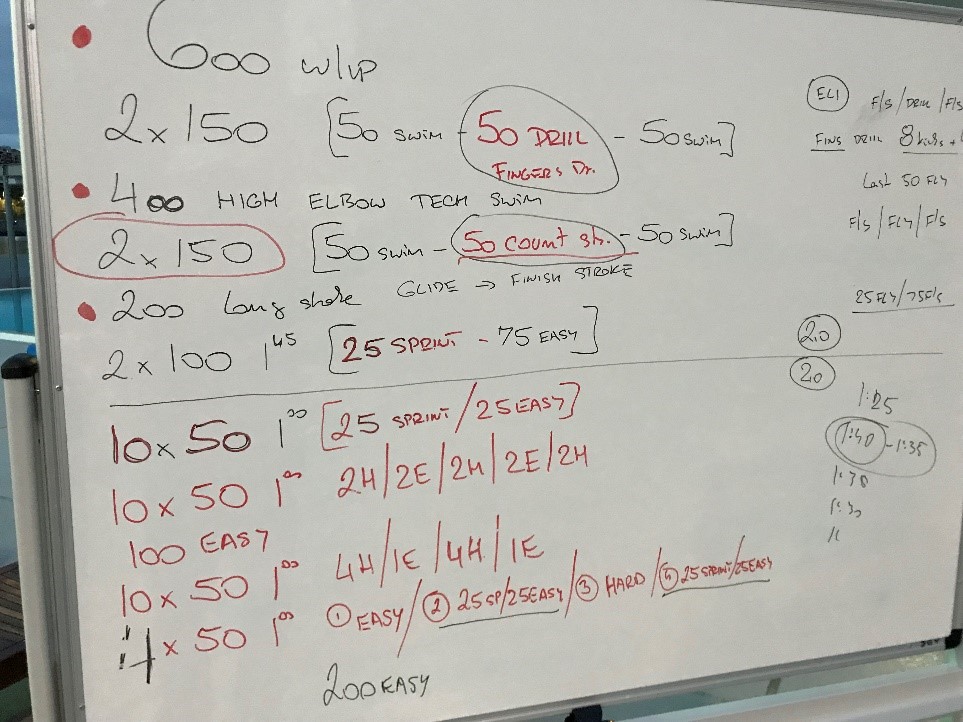
Session structure:
Warm up – includes: swim from 200-400m
50’s, 100’s, 200’s distance of drills and skills, (breathing, kick, sculling)
Main set – is the main part of the session includes: variation of swimming intensity, pull +paddles, mix strokes, IM work, Hypoxic swimming, pace work, fartlek …
Swim down – is last part of the session – swimmers cool down after main set with, kick, swim other strokes, Choice
The sessions are set up into weeks with a different challenges in each main set. Swimmers’ bodies will then adapt to the intensity. This process of adaptation builds up swimmer’s endurance. Adaptation – changes of the body biochemical, physiological and morphological structure as a result of high workout during the session.
Types of the intensity in the sessions:
Aerobic endurance intensity session develops swimmer’s cardiovascular system, improves aerobic capacity and improves the ability to transport oxygen to, and carbon dioxide away from the working muscles.
Distance: 100-2000m (long swim)
Rest: 20 – 30sec
HR: 140 – 150 B
Recovery after set: 4-10hours
Anaerobic Threshold Endurance intensity, the point at which lactic acid starts to accumulate in the muscles and develops swimmers lactic acid system. A/T set increases your ability to perform aerobic work without causing a build-up of waste products in the muscles.
Distance: 50-200m
Rest: 5sec to 40 sec
HR: 165 – 175 B
Recovery After set: 24-30hours
VO2Max endurance Intensity – is Improving swimmers oxygen system and cardiovascular system during the endurance performance. If you continue to increase your exercise intensity you will eventually reach a point of maximal exertion (i.e. you cannot work any harder than you already are).
Distance: 50- 200m
Rest: 1min